

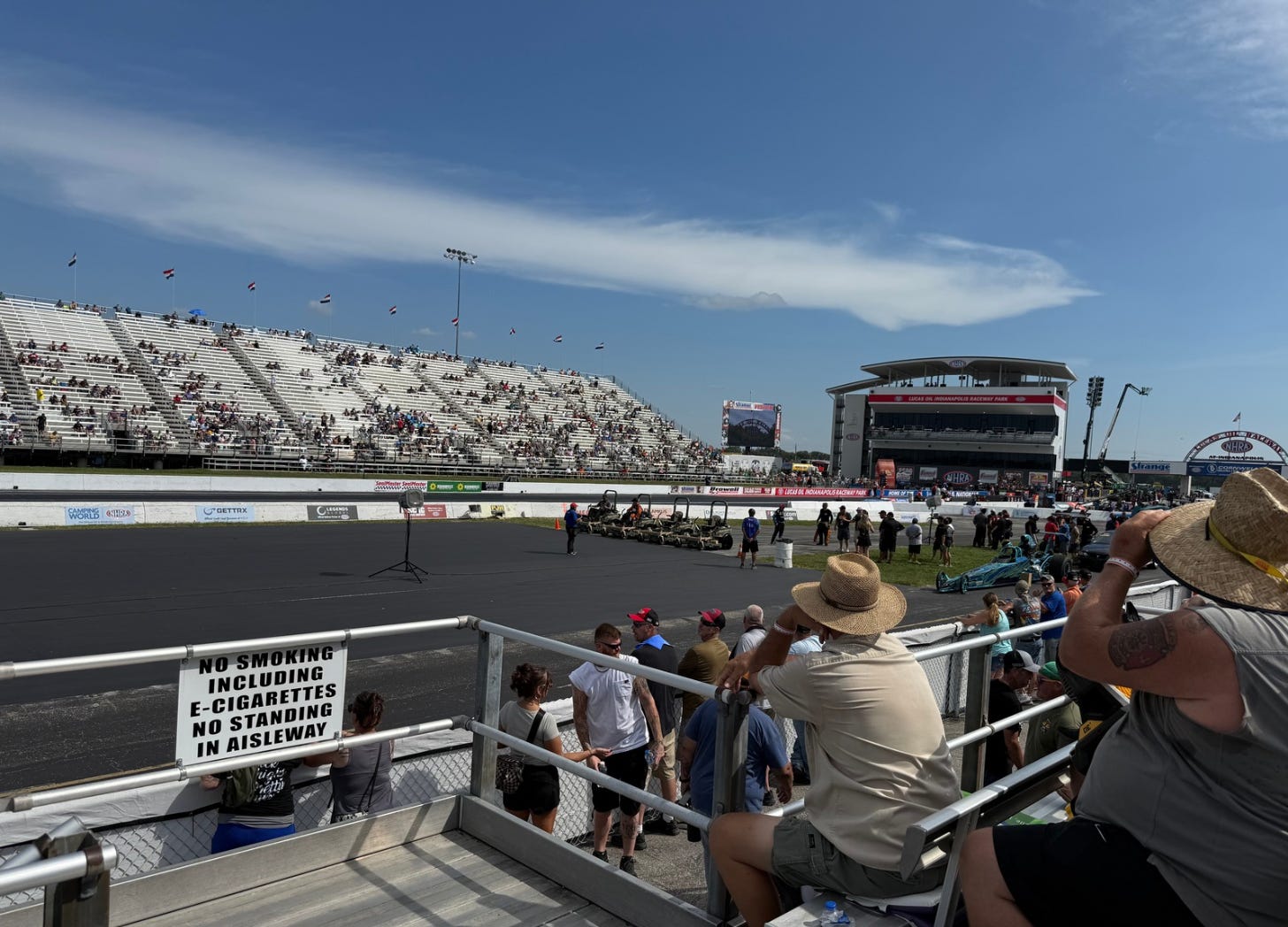
It was Labor Day Weekend, on a stifling hot day at the Lucas Oil Indianapolis Raceway Park, when an old friend leaned over on the metal bleachers and pointed around, over the roars of prepping stock cars, and shouted, “No, MAGA hats.”
Not a red golf club hat to be seen anywhere.
I was shocked, as shocked as I was a decade ago when this knock-off merchandise which looked more fitted for a participation trophy from a rec league than presidential banner became the symbol of a movement and a politician which built an era of American history.
If there was ever a place for MAGA merch, it was on Labor Day Weekend at the drag races. RVs filled the open field parking. Blue smoke covered the lot outside the track, mixing with the 100-degree humidity for a sweltering day. Gearheads displayed custom-made funny cars, slingshots, stock cars, retro-fitted station wagons, a dragster Gremlin with a toy “Gizmo” on the dash leaning into the joke.
And nary a Trump stan was to be found.
***
Throughout the year, I freelanced a trio of pieces for Washington Examiner Magazine from the Hoosier Land. All signs I saw pointed to surprising Democratic victories en route, but a blowout in the heartland of this magnitude was hard to conceive.
At this writing, the balance of power in the state House of Representatives is set to move from 70-30, Republican - Democrat, to 54-46 or even closer. The state’s House speaker — a nephew of Tom Huston, author of Nixon’s “Huston Plan” to crack down on anti-war protesters — lost his re-election in the longtime GOP bastion of Hamilton County.
This time a year ago, the President of the United States was laser focused on Indiana state lawmakers, twisting arms and threatening to sink them if they didn’t squeeze two more Republican U.S. House seats for him from an already tight Congressional map. The de facto heir to the Trump MAGA movement back then, Vice President J.D. Vance, was dispatched routinely to Indiana. But state senators, where Republicans held a 40-10 advantage in the chamber, stopped him.
Trump and the White House exacted their toll a few months later in the Republican primaries, eliminating six of the eight Republicans they targeted.
The incumbent Republicans (“RINOs”) who blocked the White House gerrymander said, repeatedly, that Hoosiers didn’t want a new map. And they were right.
If the White House had gotten its wish, instead of losing three Indiana U.S. House races this year, they would have lost eight of the state’s nine House seats, flipping the Indiana congressional delegation from 7-2, Republican to Democrat, to 8-1, Democrat to Republican, according to data compiled by Indianapolis city-county councilor Nick Roberts.
The battle was an early indicator of what would come this month, but also a sign that maybe the decade of political chaos was finally breaking.
***
In the coastal corridors of America, Indiana has been generally viewed as another solid Tetris block of Republican along I-70. And in recent decades there was good evidence to support that, starting in 2004 when then-White House budget director Mitch Daniels won the governor’s office and stretching through Tuesday.
But Indiana’s politics, a reflection of its resident’s sentiments, has always struck me as closer in nature to my home state of Maryland, a fellow border state broadly viewed by the rest of the country with a blue hue as deep as Massachusetts but closer in partisan balance than the state’s zigzag gerrymandered House map would suggest.
Throughout the year I made several trips from D.C. back to Indiana reporting mostly on my “Jesus, Sex and Politics” investigation of the state’s Christian nationalist lieutenant governor and the sex scandal in his church, I also saw the signals of discontent with current state of things in the country.
Late in the spring of 2026, I asked my editor at The Washington Examiner magazine if he’d be interested at a look at Indiana’s secretary of state race. By all rights, something no national outlet should ever consider. And yet a race for an otherwise sleepy statewide office was becoming the latest simulacrum of America’s anxiety.
(No Democrat had won statewide since 2012, a race I covered where a Blue Dog congressman, Joe Donnelly, yanked away the longtime Senate seat of Dick Lugar from a Tea Party Republican, Richard Mourdock. And an unassuming librarian named Glenda Ritz flipped the home of conservative education reform on its head by ousting state school superintendent Tony Bennett. A mustachioed former state Democratic powerbroker, John Gregg, even came within a few whiskers of upsetting rising star “Tea-vangelical” Republican Mike Pence in the governor’s race.)
But the rumblings, even screams, of discontent were there, persistently from the start of the second Trump term.
In March 2025, Rep. Victoria Spartz faced an auditorium of screaming Hoosiers — not tea partyers, but a different group of raging suburbanites livid at massive firings conducted Trump and then de-facto “co-president” Elon Musk — in the ritzy suburb of Westfield. The protestors chanted “Do your job”, Spartz told them they were wrong — a refrain which sounded an awful lot like Hillary Clinton in 2016 and the Republicans in 2026.
“Affordability” and cost of living concerns topped public polling of voters throughout the year, with gas high and diesel even higher amid the surprise Iran War topping concerns. But another, broader issue grew throughout 2026, with the first big hints emerging in Hungary as they voters tossed out longtime autocrat Viktor Orbán: Corruption.
And Hoosier pols latched on to the message.
Speaking at a picnic in St. Joseph’s County Democratic Party picnic in South Bend, a short drive from Notre Dame, one of the two scions of Indiana’s Bayh family dynasty, Beau Bayh, rallied activists blasting corruption in the state capital.
“When I see the current Secretary of State use his position of trust with the public, his office, not as it means to benefit our state, as it means to benefit himself, that kind of offends my sense of what a public servant should be,” Bayh told me before taking the mic for my Examiner article.
Another statewide candidate, Jessica Bailey, running for the easily overlooked office of State Comptroller echoed the message calling for investigations and accountability.
For much of the 2026 cycle, Indiana lacked a reliable window into voter sentiments, up until last month when veteran pollster Christine Matthews in partnership with Free Press Indiana released some fairly shocking findings: Bayh was leading Republican nominee Max Engling by 8 percentage points. She also found Bailey running neck and neck with incumbent Republican Comptroller Elise Nieshella.
“Corruption has been a big part of his paid media message, so that’s really I think resonating,” Matthews told Indiana Capital Chronicle.
A few weeks after the shocking poll, the first indication of surprising Democratic victory nationwide emerged in the Hoosier state, where polls close at 6 p.m. and (most of) the state is on Eastern Daylight Saving Time.
NBC News elections data whiz Steve Kornacki flagged the Spartz/Ford battle as one of the early bellwethers of what would come. On Election Night, Kornacki seemed surprised by massive turnaround in Indiana’s Hamilton County, a purple bastion home to many of the state’s wealthiest residents.
When it was all tallied, the same seat Spartz won by almost 20 percentage points in 2024 (56.6% - 38%) swung 22 points the other way, sending Indiana’s first openly gay state senator to Washington. J.D. Ford, in her place.
Bayh bested Republican Engling, 51.8% to 42.6%, Bailey beat Nieshella for Comptroller 50% - 47% and the Democratic nominee even came within a hair of ousting the state’s incumbent Republican Treasurer. In the state House of Representatives, Democrats easily broke a supermajority in place since 2010 and came eerily close to returning the nearly even party splits of the late ‘90s and early ‘00s.
***
For most folks who think of Indiana and the age of Trump, former Vice President Mike Pence is probably the first name that comes to mind.
Indiana is where Trump cemented his hold on the Republican Party a decade ago, first in the May 2016 primary after Ted Cruz dropped out and two months later when he picked Pence to be his running mate as part of an 11th-hour effort to stave off a party convention uprising.
Pence’s historic tour during Trump’s first term ended, fatefully, with the January 6th insurrection as Trump-backed rioters chanted “Hang Mike Pence”, built on rampant and false accusations that a vice president could refuse to acknowledge certified electors — something which for all of the country’s history had seemed to be a picayune bit of accepted machinery in the peaceful transfer of power until it was challenged with a siege of the Capitol.
Of all the stunning turns since then — Pence running against his former boss for president in the Republican primary, Trump’s triumphant return to the White House, violent and even fatal protests in the streets, National Guard which were not called in for the January 6th attack now dispatched through an otherwise peaceful Washington, Trump administration efforts to silence and censor America’s free press, and much more than can be summarized in one parenthetical — the political “death” of Pence seemed to have been sealed in November 2024.
But even Pence himself became a leading indicator of what was coming two years later.
The conservative group spun off from his 2024 White House bid grew a $20 million budget for 2025 and poached top staff from longtime conservative think tank and “Project 2025” home, The Heritage Foundation. (Veteran reporter Josh Dawsey noted a top reason for the departures was Heritage president Kevin Roberts defending Tucker Carlson’s interview of anti-semite and White supremacist Nick Fuentes.)
As the Iran War dragged on, sending gas and diesel higher and further splitting the Trump 2024 coalition, it was Vice President J.D. Vance explaining Trump, a job Pence held for four years. (Promptly after the midterm drubbing, expected 2028 candidate Vance said the Iran War was a mistake.)
When I saw Pence and former Second Lady Karen Pence this past summer at a National Press Club event for his third book, “What Conservatives Believe”, they both looked relaxed and happy. He even cracked a few jokes onstage with CBS News national correspondent Bob Costa.
When Costa asked Pence if there was enough “fluidity in the GOP electorate” to merit another run for president in 2028, Pence deadpanned: “I think you were the only reporter at my (presidential campaign) announcement, so I’m very grateful for that.”
Costa laughed and shook his head, “That’s not true.”
Following a somewhat lengthy and earnest dodge of the question, Costa followed again to see if he would run in 2028.
Pence batted it away with a smile, quoting country artist Luke Combs, “I think I rode that rocket about as far as it would fly.”
I need your support. Real reporting takes a lot of time and effort. Please contribute at PayPal or Venmo or via my GoFundMe page or with a paid subscription here on Substack.
My deepest thanks to all who have helped so far.
Tom LoBianco is the editor of 24sight News. He is an award-winning journalist and author who has covered the White House, Congress, multiple presidential campaigns and more for CNN, The Associated Press and other outlets. He has spent more than a year investigating a sex scandal inside the church of Indiana’s Christian nationalist lieutenant governor, you can get the full coverage here. Email him at tom@24sight.news.